|
Using
a wood moisture meter - FAQ
Please
click the questions below:
-
- Are
There Different Types Of Moisture Meters?
- How
Does A Moisture Meter Work?
- In What Range Of Moisture Content Do Pin-Type Meters Operate?
- At
What Moisture Content Level Do I Minimize Defects?
- How
Do I Determine the Distribution of Moisture in a Board?
- Does
Surface Moisture Skew a Delmhorst Meter Reading?
- How
Many Measurements Does Delmhorst Recommend for an Accurate Sampling?
- How
Far Should I Drive Non-Insulated Pins into Wood?
- Do I Get The Same Reading If I Use 2-Pin Insulated Or 4-Pin Non-Insulated Electrodes?
- How
Does Temperature Affect the Accuracy of Meter Readings?
- Are
Delmhorst Meters Accurate on Frozen Lumber?
- How
Do Delmhorst Meters Correct for Species Variation?
- Does A Group Species Correction Provide An Accurate Meter Reading?
- What
About Exotic Species or Other Species Not on the Charts?
- Does
the Glue Used in Plywood Affect Meter Accuracy?
- What
About the Chemicals in Treated Lumber?
- What
About Particleboard and Other Manufactured Materials?
- How
Do Delmhorst Meters Handle Readings on Rough-Surfaced Lumber
and Cupped Boards?
- Are
There Board Width Limitations in Using Moisture Meters?
- What
Happens if I Bring a Delmhorst Meter into A Dry Kiln?
- How
Can I Monitor Moisture Content During Drying Without Going Into
the Kiln?
- How
Does Static Electricity Affect Meter Readings?
- Why
Do Meter Readings Not Always Agree?
- How
Do I Keep a Delmhorst Meter in Good Working Condition?

Why
Should I Use A Moisture Meter?
Structurally
sound and beautiful in appearance, wood is the ideal raw material.
Delmhorst customers in the woodworking/lumber industry know that
moisture content is the single most important factor affecting
the quality of their products.
To
ensure quality, from the mill and dry kiln to the finishing floor,
Delmhorst moisture meters help minimize defects such as shrinkage,
cracks, and splits. Years of experience, high-tech tools and controls,
and premium grade lumber cannot make a difference if moisture
content goes unchecked.
^
Top

Are
There Different Types Of Moisture Meters?
There
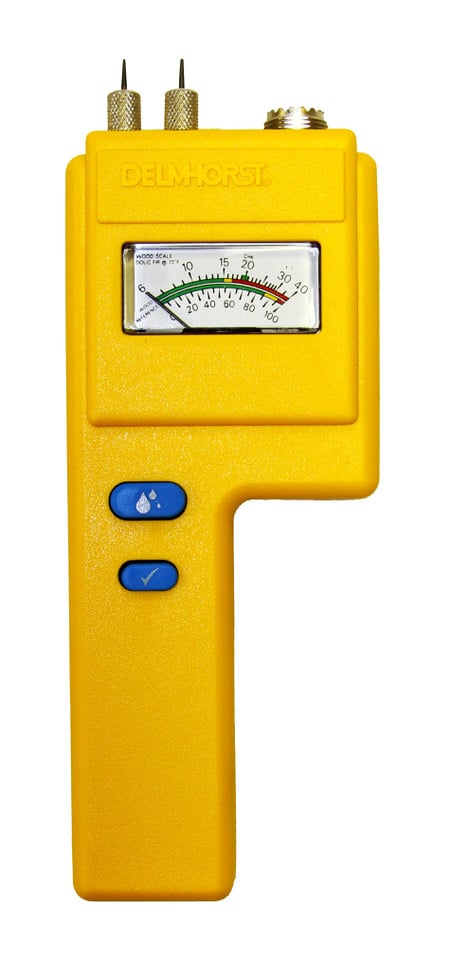
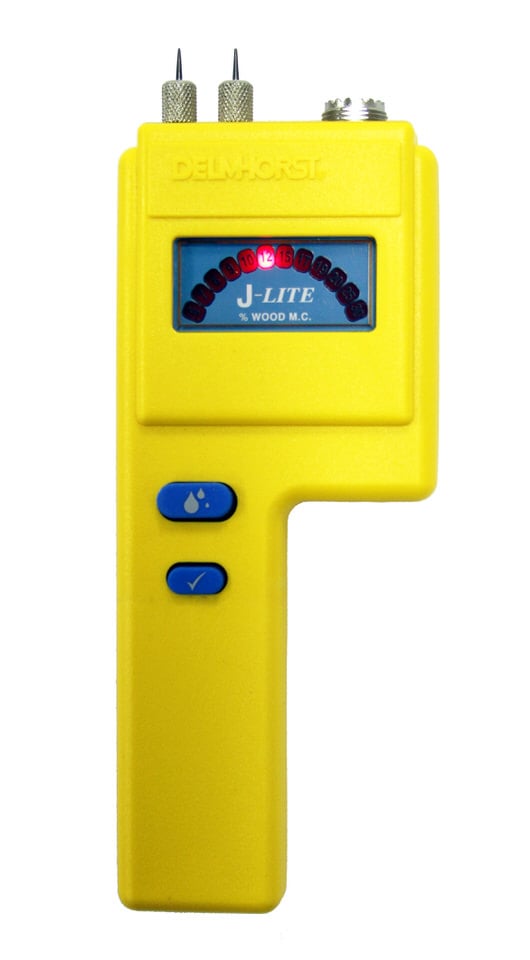
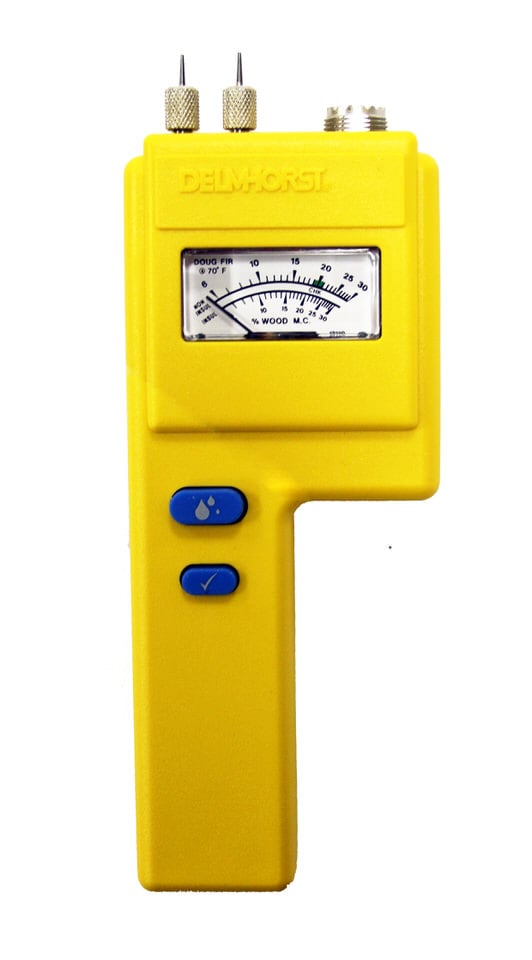
are two types of moisture meters commonly used in lumber and woodworking
applications.
A
pin-type uses two pins that penetrate into wood at the users desired
depth. Pin-type meters are the only instruments that indicate
the moisture conditions inside a board or a piece of wood. Using
insulated pins, only the uncoated tips are exposed to the wood
fiber, providing more accurate readings of moisture content at
various levels of penetration. Using a pin type meter with insulated
pins is still the most effective method to determine moisture
gradient, which is the difference between shell and core moisture
content.
Pinless
moisture meters read moisture closest to the source of the magnetic
field, in this case, at the surface. For quickly scanning finished
product, a pin-less meter is a convenient way to identify a problem
area. However, a pinless meter cannot differentiate between shell
and core moisture content and will not detect a moisture gradient.
Also, readings provided by a pinless meters are affected by surface
moisture.
Please
refer to the diagram below for a basic look at the difference
between readings obtained from a pin-type meter compared to a
surface meter.

This
diagram illustrates that pin-type meters and surface meters provide
different information about the moisture content in a board. Each
technology may be appropriate for different applications. Before
choosing a meter, it is important to understand these differences
in readings and choose the type of meter best suited for your
particular application.
^
Top

How
Does A Moisture Meter Work?
Using
the principle of electrical resistance, pin-type meters use the
board as an element in a circuit by driving two pins or electrodes
into it. This method works because moisture conducts electricity
well and dry wood is an effective insulator.
Most
pinless meters use the capacitance method, which uses the relationship
between the moisture content and the dielectric properties of
the wood.
Both
the resistance and the dielectric properties of wood change in
direct proportion to its moisture content, within a specific range.
^
Top

In What Range of Moisture Content do Pin-Type Meters Operate?
Resistance-type meters express moisture content as a percentage of the oven-dry weight of the wood. These meters work best from teh range of fiber saturation point (25 to 30 percent) down to around 6 percent. Below 6 percent, it's tough to make accurate, repeatable readings because of the high electrical resistance in really dry wood. This particulary true at low relative humidity levels, generally below 30 percent.
Electrical accuracy of all Delmhorst meters is better than 0.5 percent between 6 and 12 percent moisture content; better than 1 percent between 12 and 20 percent moisture content; and better than 2 percent between 20 and 30 percent, or at fiber saturation point. You can check accuracy either through the internal check or with a Moisture Content Standard.
^ Top

At
What Moisture Content Level Do I Minimize Defects?
Acceptable
moisture content depends on the final use of the wood. Wood for
fine furniture should be dried to 6 to 8 percent in most areas
of the country, with very little variation among pieces and between
the shell and core. (Figure II)

Appropriate
moisture content is also climate-driven. To determine the attainable
moisture content - or equilibrium moisture content (EMC) - in
your part of the country, hang small, thin samples of a wood species
in your shop or plant and taking daily readings. When the samples'
moisture content remains constant, they have reached the equilibrium
level. This level will change from season to season, but you'll
know the range within which to work. (Figure III)

^
Top

How
Do I Determine the Distribution of Moisture in a Board?
Here's
where Delmhorst recommends the use of a pin-type moisture meter.
First,
to determine how the moisture is moving through a board, make
a series of shell readings in the layer just below the surface;
then make a series of core readings, closer to the center of the
board thickness. The Delmhorst 26-ES electrode with insulated
pins is the easiest and surest way to detect a moisture gradient.
Since
the 26-E pinpoints are not insulated, two or three quick readings
at different levels of penetration will indicate if the board
is well seasoned, or properly dried. A normal gradient usually
develops from the wetter core to the drier surface, with an average
reading at between 1/4 to 1/5 of the board thickness. Even non-insulated
pins, which measure the wettest fibers, will provide a good indication
of how the wood is drying.
If
you are using non-insulated pins, push the pins just about 1/16"
into the surface, read the meter, and then push the pins to their
full depth. For kiln-dried stock, the final reading should be
between 6 and 12 percent; with your first reading about 1 percent
lower. For air-dried stock, the final reading is typically between
12 and 19 percent, with the first reading between 2 and 3 percent
lower. Meter readings outside of these ranges indicate that the
board is poorly seasoned.
Pin-less
meters scan through the cross section of a board taking into account
the moisture in the entire penetrated area. If there is a high
concentration of moisture at the surface, the reading will be
skewed to reflect this surface moisture. If the surface is dry
and core moisture exists, the readings will be lower than the
representative moisture levels throughout the board.
^
Top

Does
Surface Moisture Skew a Delmhorst Meter Reading?
Moisture
caused by exposure to rain, fog or high relative humidity is easily
and accurately detected with insulated pins.
If
you're using non-insulated pins, push them 1/16" into the wood
and read the meter. Then push them to their full penetration.
The meter reading should increase by 1 to 2 points, just because
of the greater contact. If there is no increase, or the increase
is less than 1 percent, the wood is wet on the surface and the
readings are unreliable.
As
described in the answer to the question above, readings taken
with a surface meter are affected by surface moisture, making
it difficult to determine if the surface moisture is a result
of standing water caused by rain, or if it is representative of
the moisture content throughout the board.
^
Top

How
Many Measurements Does Delmhorst Recommend for an Accurate Sampling?
Accuracy
of the readings depends on how representative the samples are
of the entire load. In an ideal situation, when all the boards
in a load have the same moisture content, and the distribution
in each board is uniform, only a few readings are needed.
But
since this ideal condition doesn't often happen, start by checking
a large percentage of pieces. If the readings are within close
range, it's apparent that the load is fairly uniform. For critical
use, check 5 or 10 percent of the load, and be sure to look at
boards from all parts of the load. Check slower drying quarter
sawn boards as well as flat sawn lumber. If you can only drive
pins into the edge, be sure to use the longest pins available
to reach the fibers as deep as the board is thick.
The
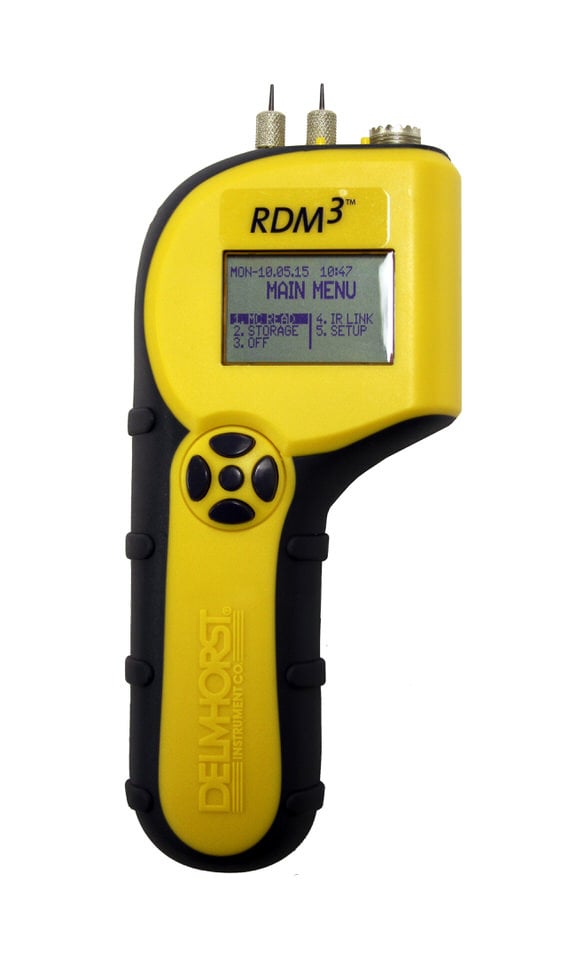
Delmhorst RDM series moisture meters with data collection and
statistical analysis capabilities are ideal for simplifying the
entire sampling procedure and providing backup documentation.
^
Top

How
Far Should I Drive Non-Insulated Pins into Wood?
To
full depth if possible. However, at moisture levels below 10%,
it is usually sufficient to make good, positive contact with the
wood. At higher levels of moisture and especially if you have
a steep gradient, full penetration is a must. Otherwise you can
have discrepancies between meter readings and actual moisture
content of as much as 5 or 6 points, especially in the range above
20 percent. For best results in such cases, use insulated pins.
^
Top

Do I Get The Same Reading If I Use 2-Pin Insulated Or 4-Pin Non-Insulated Electrodes?
The original Delmhorst calibration was developed with a 4-pin electrode - four non-insulated steel needles, with 5/16" penetration - in samples with uniform moisture distribution. For greatest accuracy, a small correction is necessary when using electrodes with two insulated pins. The latest Delmhorst models available are calibrated either for the 2-pin electrode only, or are programmable for both 2-pin and 4-pin electrodes.
^ Top

How
Does Temperature Affect the Accuracy of Meter Readings?
After
moisture content and a moisture gradient, if one exists, wood
temperature is the most important factor affecting the accuracy
of your readings. As wood temperature increases its electrical
resistance decreases and indicated moisture content rises. The
lower the temperature, the lower the indicated moisture content.
Depending on the temperature and moisture content, you may have
to make a correction.
Delmhorst
meters are calibrated at 70° F (20° C). In field use,
no correction is necessary if the wood temperature is between
50° F and 90° F. If the temperature correction is not
built in the meter, use the slide rule or chart we supply with
each meter.
The
temperature of the wood does not affect pin-less type meters,
unless the lumber is frozen.
^
Top

Are
Delmhorst Meters Accurate on Frozen Lumber?
As
long as the wood is not frozen solid and remains conductive, a
pin-type meter will give reliable readings. However, most instrumentation,
unless specifically designed for extreme weather conditions, will
not work well in constant sub-freezing temperatures.
^
Top

How Do Delmhorst Meters Correct for Species
Variation?
When
using a pin-type meter, all species yield different readings at
the same moisture content. This is due to the fact that the electrical
characteristics of different wood species vary. Delmhorst uses
the USDA standard - Douglas Fir - as the basis for all calibrations.
When
using a Delmhorst meter on other species, either refer to the
species correction chart, or key in your species into one of our
microprocessor-based meters for an automatic correction.
Pinless
meters also yield different readings for different species. However,
instead of electrical characteristics affecting the readings,
wood density affects the readings. Refer to the species correction
chart enclosed with your meter to adjust the readings accordingly.
^
Top

Does A Group Species Correction Provide An Accurate Meter Reading?
Species corrections are most accurate when handled as an individual correction, either through the a species correction chart, or automatically, through software. While not as accurate as individual corrections, the group correction is adequate for practical purposes, as long as the correction is close to the individual factor for the species.
^ Top

What
About Exotic Species or Other Species Not on the Charts?
Call
us at 1-800-222-0638. We maintain calibration data for a wide
variety of exotic species. Or, you may contact the USDA Forest
Products Lab in Madison, Wisconsin by calling 608-231-1361 or
via e-mail at info@forestprod.org.
If
the species correction is simply not available, you can take readings
below 10 percent at face value. Any correction is so small that
depending on the application; a correction may not be necessary.
A
good moisture meter is still valuable, even without a correction
factor because you can use it to determine the equilibrium moisture
content (EMC). A meter reading by itself is not always as important
as allowing the wood to attain its EMC level where it won't change
dimension, crack, or split.
^
Top

Does
the Glue Used in Plywood Affect Meter Accuracy?
In
most cases, no. To verify this, use insulated pins to make individual
tests by touching the outer ply, glue lines, and center plys.
If the glue reads the same as wood, use the meter on plywood as
you would any solid material and take the readings at face value,
without species correction.
^
Top

What
About the Chemicals in Treated Lumber?
Recent
studies have shown that you can use a Delmhorst meter with confidence
at the treating plant, job site, or when the wood is in service
if the preservative is a "C oxide" formulation (CCA-C) widely
used today. Our experience has shown that at higher moisture content
levels (above 20 percent), chemically treated lumber tends to
yield somewhat erratic readings.
^
Top

What
About Particleboard and Other Manufactured Materials?
Chemical
additives may or may not affect meter readings. Use the meter
to make qualitative, comparative readings. If greater accuracy
is required, Delmhorst can help you to develop a specific calibration.
^
Top

How
Do Delmhorst Meters Handle Readings on Rough-Surfaced Lumber and
Cupped Boards?
With
a pin-type meter, these conditions are not a problem. Just drive
the pins as you would normally, insuring firm, positive contact
and detect unknown gradients. Pin-less meters, however, need full
exposure to a flat surface so their readings on some uneven surfaces
may be unreliable.
^
Top

Are
There Board Width Limitations in Using Moisture Meters?
Board
width is not a limiting factor when using a pin type moisture
meter. As long as the pins make good contact, the meter can be
used on anything from small dowels to wide planks.
For
accurate results with a pinless meter, the material you're testing
must be at least the width of the scanning area on the bottom
of the meter.
^
Top

What
Happens if I Bring a Delmhorst Meter into A Dry Kiln?
Moisture
meters, like most precision instruments, are sensitive to moisture.
We do not recommend taking a meter into a kiln, especially from
cold surroundings. If you must, take a few minutes to warm up
the meter and electrode to a maximum 100°F, so that the higher
temperature and moisture levels in the kiln will not affect the
meter for a few minutes. If you don't acclimate the meter, readings
will be erratic at best.
While
Delmhorst meters are built for the harsh mill environment, continued
exposure to high heat and humidity will invite corrosion and shorten
the life of a meter's keypad, display and PC board components.
^
Top

How
Can I Monitor Moisture Content During Drying Without Going Into
the Kiln?
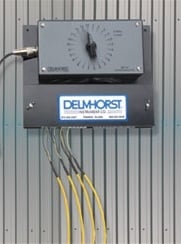
Use
the Delmhorst Kil-Mo-Trol, a remote probe system that measures
the moisture content of lumber during the drying process. Resistance
probes or contact pins are located at various "stations"
throughout the lumber packages to monitor shell and core or core
only moisture content readings. This technique is proven for both
hardwood and softwood drying, and can be used in any type of dry
kiln, pre-dryer, or air-drying operation. For more information
about Kil-Mo-Trol, please close this window and click on the Kil-Mo-Trol
Moisture Monitor button.
^
Top

How
Does Static Electricity Affect Meter Readings?
In
cold and/or dry climates, static charges may cause erratic meter
readings in the range below 8 percent. Measuring such high resistance
under these conditions is difficult enough, but the winter months
can make it more so. The analog meter pointer "jumps" all over
the scale or the digital display may flash erratic numbers. To
minimize the effect of static:
- Try
not to let the electrode cable dangle.
- Drive
the electrode pins into the wood with the meter turned off,
and then turn the meter on when you are ready to take the reading.
- After
driving the pins, place your hands next to them on each side
of the electrode to help discharge the static from the board.
- You
can also try passing a damp cloth over the board's surface to
pick up any static charges before driving the pins.
Depending
on the conditions, any one of them can work, either alone or in
combination with another.
^
Top

Why
Do Meter Readings Not Always Agree?
If
two meters are not of the same manufacturer, readings will likely
not correspond, because of the different calibrations used. Made
in the USA, Delmhorst meters are calibrated on the USDA standard,
while foreign made meters use other standards and often have different
species and temperature correction factors.
Even
readings on two meters of the same manufacturer may vary. Assuming
both meters are electrically correct, the difference usually can
be attributed to use of different electrodes, pin penetration,
and species and temperature corrections. When meters are used
for lumber inspections by vendors and buyers, the two parties
should have a basis for comparing readings obtained with the instruments
they are using.
^
Top

How
Do I Keep a Delmhorst Meter in Good Working Condition?
Delmhorst
moisture meters are well known for their ruggedness and ability
to withstand years of rough handling. Like any testing instrument,
a little care goes a long way toward trouble-free service:
- Store
the meter in clean, dry place
- Change
batteries and pins as needed
- Keep
the meter and electrode clean by using any biodegradable cleanser
sparingly on external parts only.
If
you have any doubt about the working condition of your meter,
send it to Delmhorst. We can repair and re-calibrate your instrument
to its original standards and return it to you quickly.
If
you have any further questions on using your moisture meter, please
call us at 1.800.222.0638 or fill out our Request Form under "Contact
Us".
^
Top

|